
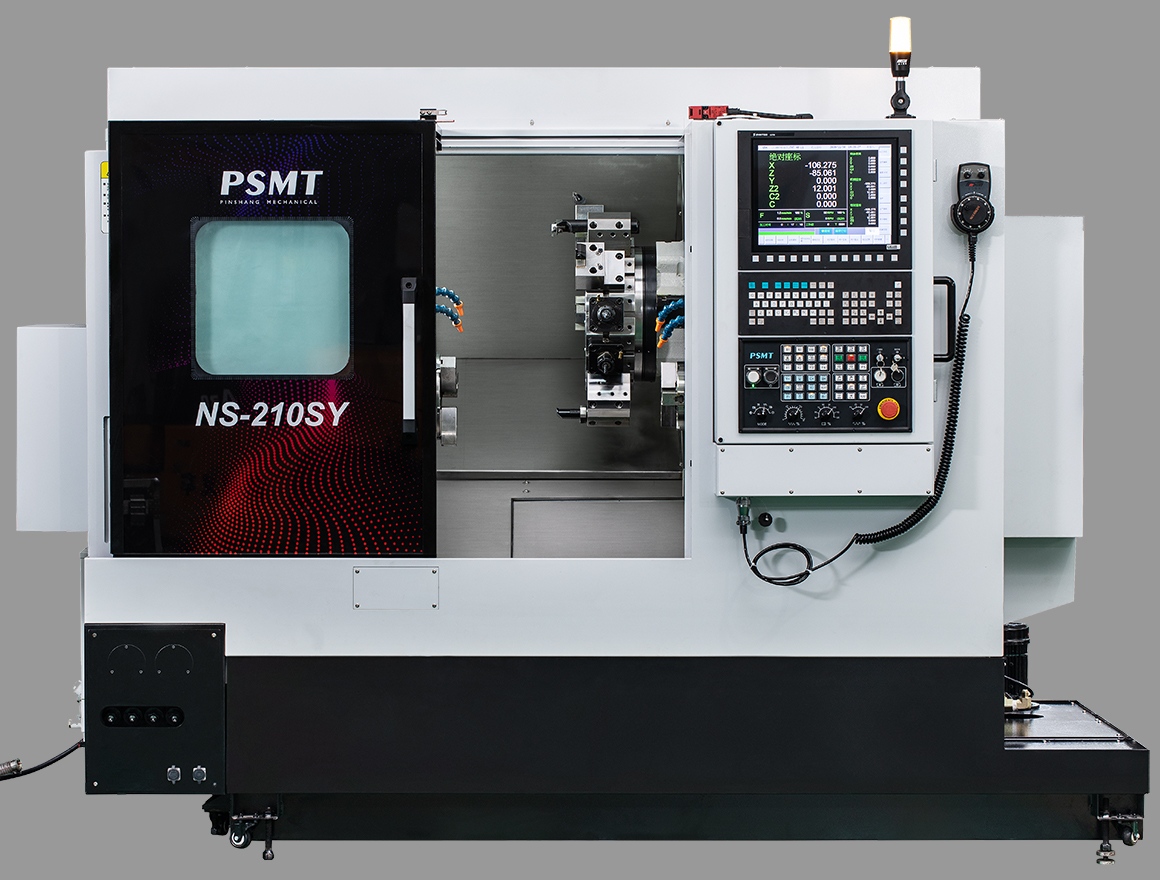
A part that needs both a turned diameter and a milled face can be made two ways. It can go on a lathe, come off, and go onto a milling machine. Or it can be made in a single setup on a turn-mill centre, where the spindle holds the workpiece and a driven tool turret cuts while the part rotates or is held still. Both routes produce a good part. The difference shows up in lead time, in cost per piece, and above all in how well the milled features line up with the turned ones.
What a turn-mill centre actually does differently
On a conventional lathe the tool does not rotate. On a turn-mill machine some or all of the turret stations carry their own drive, so an end mill or drill can spin at its own speed while the main spindle is indexed to an angle and locked. That one capability removes a whole class of problems. Flats, keyways, cross-holes, hex forms, slots and tapped holes on a turned body can all be cut without taking the part out of the chuck.
The real saving is in setups, not cycle time
It is tempting to compare the two routes on cycle time alone, and on that measure the result is often close. A turn-mill cycle can even be longer, because driven-tool operations are slower than the same cut on a dedicated machining centre with a rigid spindle. The saving lies elsewhere.
Every time a part is removed and re-fixtured, three costs appear. There is the labour of loading and clocking it in. There is the fixture itself, which has to be designed, made and stored. And there is the positional error that re-location introduces, which is usually the largest of the three in engineering terms. A cross-hole drilled in a second setup carries the error of the first setup plus the error of locating on the turned diameter. Cut on a turn-mill in one setup, it carries only the machine positioning error.
When turn-mill is clearly the right answer
- Tight relationships between turned and milled features. If a keyway has to be held within a few hundredths of a millimetre relative to a bore, or a cross-hole must be truly perpendicular to the axis, one setup is the straightforward way to get it.
- Slender or thin-walled parts. Re-clamping a long shaft or a thin sleeve risks distorting it. Fewer clamping events means a straighter part.
- Medium batches of complex turned parts. Between roughly fifty and a few thousand pieces, the programming time is amortised and the labour saving on each piece is real.
- Parts with features on several angular positions. A body with four tapped holes at ninety degrees is one indexing program, not four fixtures.
When separate operations still win
Turn-mill is not automatically cheaper. A few situations argue the other way.
If the milled feature is heavy, a dedicated machining centre removes material faster and with less chatter than a driven tool on a turret. A deep pocket or a large face mill cut belongs on a mill. If the part is simple, say a plain turned bush with one cross-hole, the extra programming on a turn-mill can cost more than the second setup it saves. And for very large production runs the economics change again: a dedicated line with simple single-purpose fixtures can beat a flexible machine on cost per piece, because the flexible machine is the more expensive asset per hour.
What to send us so we can advise properly
The decision is usually obvious once the drawing is in front of us, but three pieces of information settle it quickly. First, the geometric tolerances between turned and milled features, not just the size tolerances. Second, the annual or batch quantity, since that moves the balance between setup cost and cycle cost. Third, the material and whether the part is prone to distortion, because that often decides the question on its own.
We run both conventional lathes and turn-mill capability, so we are not pushed towards one answer. Send the drawing and the quantity and we will quote the route that costs you least for the tolerances you actually need.